
Costs Reduced – Reliability Improved at Midwest Manufacturer
Jan, 16 2026
Case Studies
Midwest Manufacturer
For more than 50 years, this manufacturer has delivered superior aluminum castings that meet the specifications of the world’s most demanding industries. To guarantee that their customers have the best products delivered on time, they keep a thorough watch of their critical cooling and compressed air systems.
Applications: Roof Top and Mezzanine Heat Exchanges
Market: Manufacturing
Challenge
This Midwest manufacturer of aluminum castings was challenged with reducing scrap and related costs. One area of interest was their cooling system performance. If the aluminum parts were cooled too quickly, they would shrink and become out of specification, resulting in high scrap costs, increased costs of quality monitoring, and ultimately an unsatisfied customer. The plant wanted to start small and concentrate on monitoring what could have an immediate impact. They also needed the entry cost to be low with minimal costs associated with engineering, integration, and installation services. Lastly, they wanted the system to be able to scale in size and be able to mix and match hardware and connectivity of cellular and Wi-Fi technologies, all while using the same provider for software and setup support.
Previously, this Midwest manufacturer would walk to the assets and check the local gauges to monitor temperatures and pressure. The major concerns were reducing unnecessary tasks, improving the reliability of the operation, and understanding what is happening with the systems at all times.
“It was always a hassle to keep track of the heat exchangers, especially when we are struggling to hire enough people. There are so many tasks, and our clients never want to run out of our products”, said Maintenance Manager.
Solution
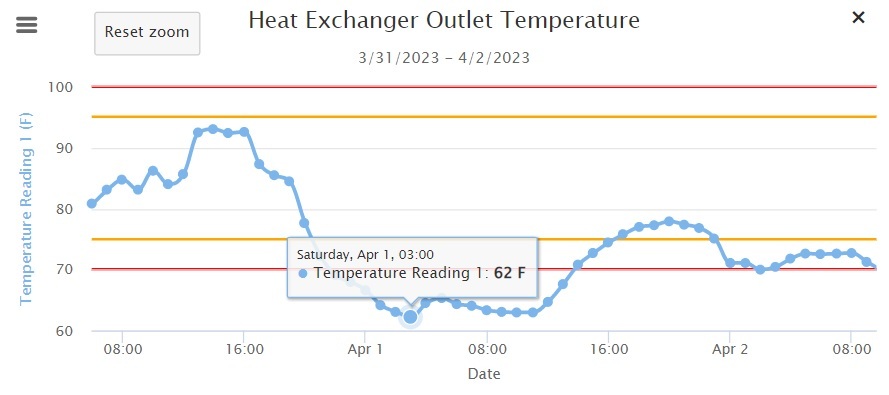
In 2023, this Midwest manufacturer installed the TankScan TSG cellular to 4-20mA sensor gateway at their Midwest location to monitor their critical heat exchangers. The monitoring system leverages cellular wireless technology, battery power, magnetically connected temperature sensors, ¼” NPT pressure sensors, and a cloud software application for the complete solution. The measurements are viewed from a PC at an office, or from any PC, laptop, or smartphone connected to the internet. The system is designed for temperature, pressure, vibration, and level monitoring. The user is provided with accurate readings to the visual devices they already own, understand, and support. The image below shows the telling sign of the stuck temperature control valve, allowing a 35° F swing in supplied cooling water temperature.
Results
The manufacturer has seen numerous benefits from performance monitoring, including:
• Immediate discovery of a failed temperature control valve
• Reduced labor associated with inspection rounds
• Improved reliability of their operations with remote visibility to off-site and on-site personnel
• Improved confidence and reduced risk of out-of-spec product
“The wireless heat exchanger monitors give us the confidence we need to keep our production tools running with a reliable and consistent supply of cooling water. It has uncovered a legacy issue of a stuck valve and has been worth every penny”, said Jim.
Need help with your equipment or a quote? Whether you're a current customer or exploring our products, we're here to help you.